
For Fractional CFOs & Finance Firms
Make the planning process repeatable. Keep the advice client-specific.
Every client brings numbers, assumptions, and decisions. Your process should not start from zero. RunwayCal gives you a consistent structure for turning each client's financial reality into a conversation about what happens next.
01 / The client advisory loop
Every client is different. The process does not have to be.
Advisory work follows a clear rhythm. Start with the client's reality, structure the plan, test what changed, and carry the reasoning into the next review. New actuals begin the loop again.
Client reality
Start with actual activity, commitments, and assumptions.
Structure the plan
Build the forward view around what matters to this client.
Understand change
See which movement or assumption changed the picture.
Test the next move
Examine the consequence before the client commits.
Explain the consequence
Turn the result into a tradeoff the client can understand.
Review and report
Carry the logic into the next client conversation.
02 / Client financial reality
Start with the client's real financial picture.
Accounting shows what happened. Advisory begins there and asks what comes next. Cash, revenue, commitments, team costs, budgets, and activity need to tell one coherent story.
RunwayCal is a connected financial planning operating system for growing businesses. It gives the conversation a structured starting point without replacing bookkeeping, the general ledger, or your judgment.
Explore the Financial Map03 / Structure the plan
Build the plan around what matters to this client.
Planner gives the conversation a structure. Keep assumptions visible, compare the plan with what is now known, and show where the picture moved before discussing what should change.
Explore Planner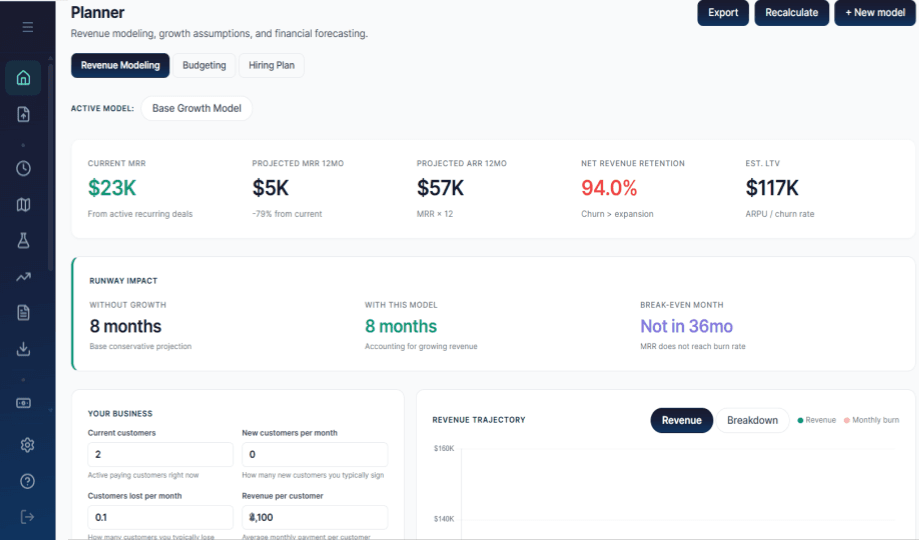
04 / Test the next move
Test the decision before the client commits.
The assumption changed. Show the client what that changes next. A scenario keeps the possible response separate from what has already happened.
Define the assumption, compare the consequence, and explain the tradeoff. The practitioner interprets the result; RunwayCal does not choose the recommendation.
Explore Scenarios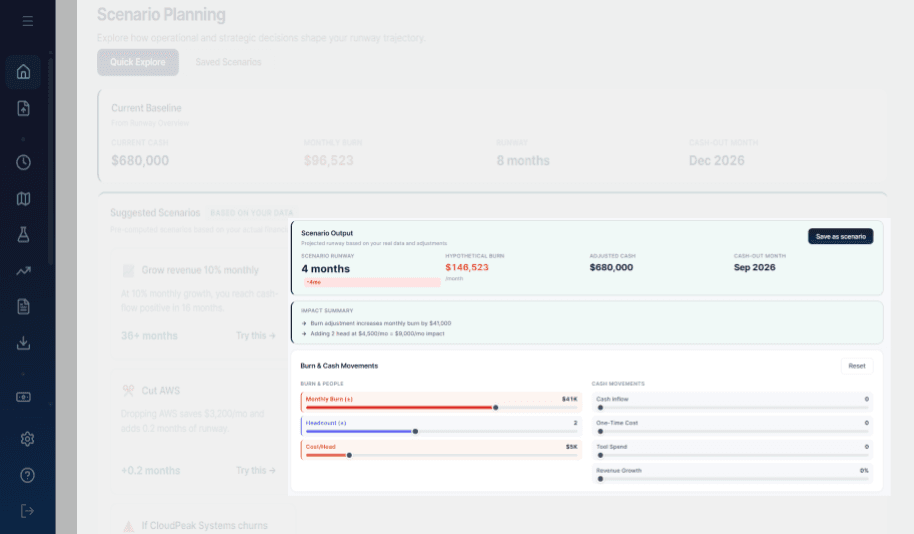
05 / The next conversation
The client does not need another number. They need to know what changed.
Advisory value comes from connecting the movement to the decision. Keep the evidence, the assumption, and the consequence close enough that the client can challenge the reasoning and understand the tradeoff.
That creates a better review: less time rebuilding context, more time deciding what to do with it.
Name the movement.
Connect it to the plan.
Define what can be tested.
Explain the consequence.
Carry the decision forward.
06 / Connected financial picture
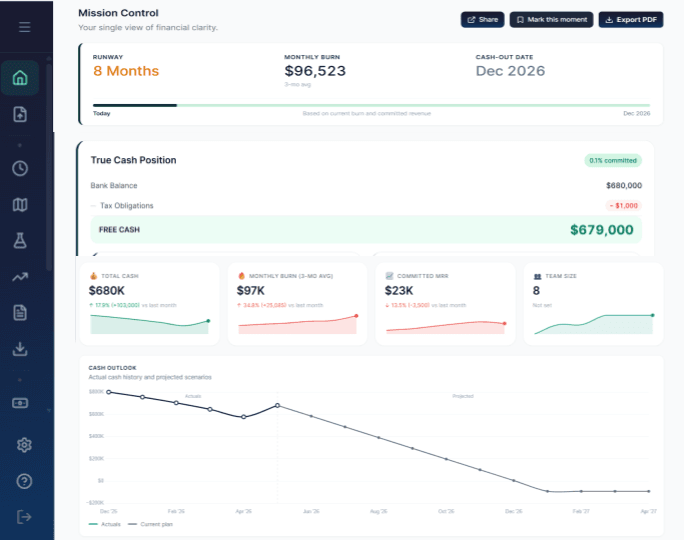
Bring the question back to the whole financial picture.
RunwayCal connects your commitments, cash, revenue, teams, budgets, and scenarios into one financial picture, so you can see what's happening, what's coming, and how your business changes when you make your next move.
07 / Reporting
Report without rebuilding the story.
A report preserves the logic behind the recommendation. The client should be able to see which input moved, which assumption was tested, and why the next decision follows.
Financial Statements, exports, Board Access, and investor reporting can carry the analysis into the next conversation. They do not replace the practitioner's explanation or distribute advice automatically.
08 / Repeatable advisory method
Use the same planning discipline. Keep every client picture distinct.
A repeatable process creates leverage without flattening the work. Each engagement still begins with that client's reality, assumptions, and decisions. The method repeats; the advice stays specific.
Client A
Client B
Client C
Built for practitioners delivering ongoing planning and advice across client relationships, including virtual CFO firms, finance consultants, FP&A consultants, and startup finance firms where the work fits. Today, each client remains in a separate RunwayCal organization. Advisory Workspace is in development, so the conceptual tracks above are not a native cross-client dashboard. See current plans and availability.
Repeat the discipline. Keep the advice specific.
Spend more time on the decision, not rebuilding the process.
Give each client a clear planning rhythm while keeping the judgment, context, and recommendation in your hands.