
Revenue Concentration
Revenue concentration shows how much of your revenue comes from one customer or a small group of customers.
The higher the concentration, the more a change with one customer can affect the business. The level of risk depends on the wider financial context.
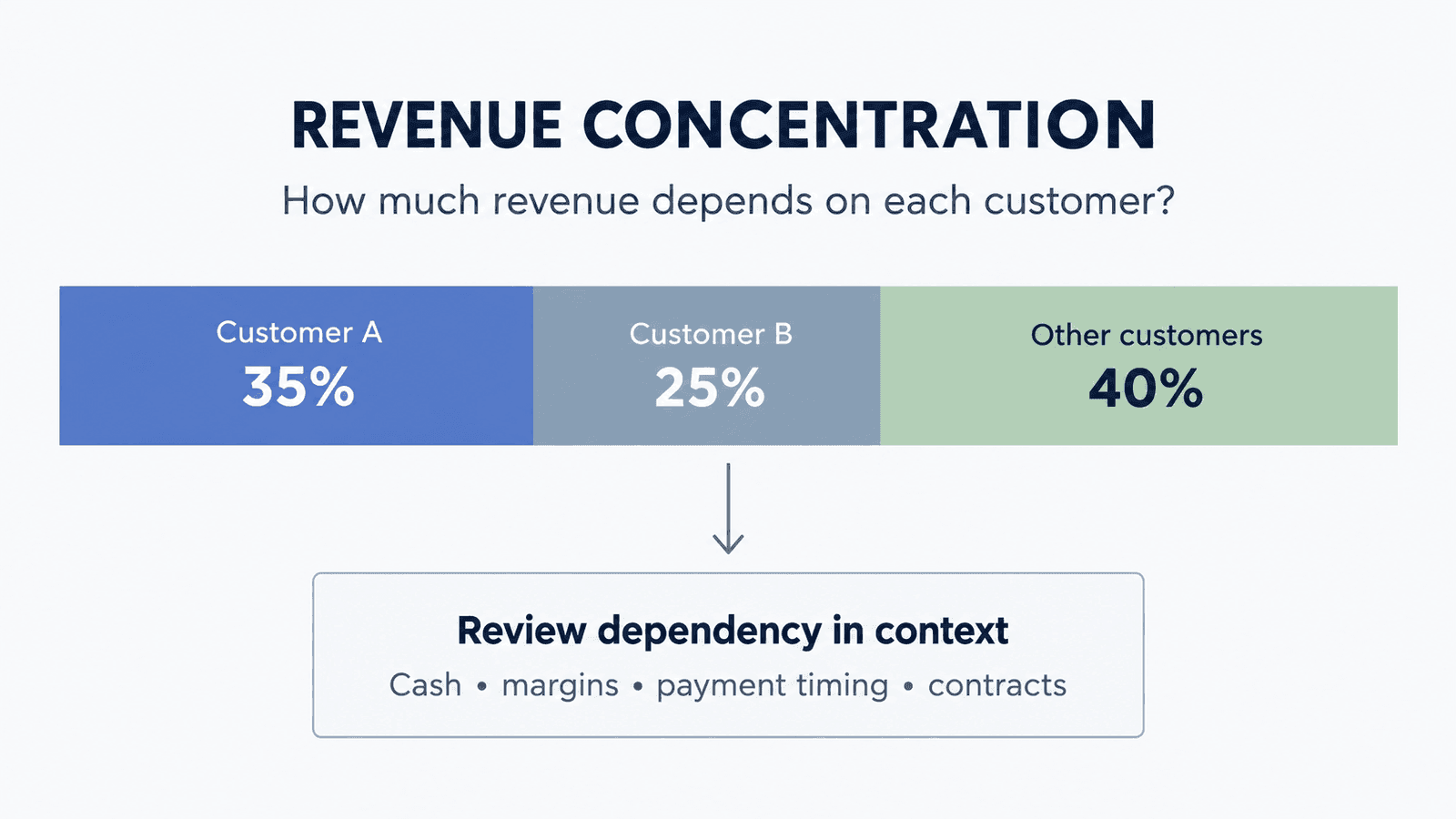
The percentage is a starting point for review, not a universal verdict.
What is Revenue Concentration?
Revenue concentration measures how dependent a business is on a small number of customers.
For example, if one customer provides 35% of total revenue, that customer represents a 35% revenue concentration.
The percentage itself is not a verdict. A business should review it alongside cash, margins, payment timing, contracts and how easily lost revenue could be replaced.
Revenue concentration is not the same as collection risk
Revenue concentration asks how much revenue depends on a customer.
Collection risk asks whether money expected from that customer is arriving as planned.
A customer can represent a large share of revenue and still pay reliably. Another customer can represent a smaller share and still create a collection problem.
Why it matters
A large customer can be a strength, but it can also make the business more sensitive to one relationship.
If that customer pays late, reduces its spend or leaves, the effect can show up quickly in revenue and cash.
Tracking concentration helps you see that dependency clearly before making hiring, spending or growth decisions around it.
Example
A business earns $100,000 in monthly revenue. One customer accounts for $35,000.
That customer represents 35% of monthly revenue.
The next question is not whether 35% is automatically good or bad. It is how much the business depends on that revenue and what would change if it arrived late, reduced or stopped.
How RunwayCal helps
RunwayCal can calculate revenue concentration from supported deal and receipt data and show when a customer relationship represents a meaningful share of the revenue being reviewed.
The current actionable-insight rule uses 50% of committed revenue as one RunwayCal review threshold. That threshold is a review trigger, not a statement that the business is unsafe.
Common mistakes
- 1Treating one percentage as a universal risk limit.
- 2Looking at concentration without payment timing.
- 3Checking concentration only once a year.
Get the Financial Clarity Newsletter
Practical tips on cash flow, runway, and financial decisions for founders, business owners, CFOs, investors, and board members. Free, weekly, no spam.
Related terms
See how much revenue depends on each customer.
Review concentration alongside the rest of the financial picture before making the next decision.
Explore Revenue Intelligence